• Work
  • Today
  • Periphery
  • About
  • Contact
Felicity Fenton
  • Work
  • Today
  • Periphery
  • About
  • Contact

Conveyance with Lou Watson on Freeform Portland

Today at 10am I'll be chatting with video and sound artist Lou Watson on Bachelard's Panty Drawer. We'll be discussing her latest project Score for Traveling I-5 along with the dreaded commute, highways, suburbs and things on wheels that carry humans here, there and everywhere. I'll be playing songs by Bruce Springsteen, Harumi, US Girls, Toni Fisher, Public Enemy and many others, all in theme of "conveyance." Tune in online at freeformportland.org/listen or dial it up in Portland at 90.3 fm.

Below is one of Lou Watson's highway scores titled Section of I-705, on a Wednesday, for Electric Piano. For your listening and viewing pleasure. 

tags: freeform portland, freeform radio, bachelard's panty drawer, Lou Watson, Conveyance, Transportation, Talk Radio, bruce springsteen, Harumi, US Girls, Toni Fisher, Public Enemy, artists I like, artists I love interviews
Saturday 12.03.16
Posted by felicity fenton
 

The Ever-Enchanting Miss Mary Edwards

Several years ago on a plane headed to the frosty hills of Goddard College, I met a lady named Mary Edwards. Her razor sharp wit, infectious charm and delicious smell, quickly drove me into her life and we’ve been amigas ever since. Mary plays with space, and the sounds in and in between those spaces. As a composer, songwriter and sound artist whose projects range from recordings and performances "evocative of epic cinematic soundtracks combined with lyrical intimacy..." (Time Out NY), to immersive environmental and architectural sound installations, her work is informed by themes of temporality, impermanence, nostalgia, longing, childhood and the natural world. 

I present to you, an informal Q and A with Ms. Mary Edwards:

I love the notion of paying close attention to the spaces between, which is one of the many reasons I appreciate your work. You have a keen sense of finding hidden gems and translating those spatial energies into sound. Where did you first tune into this gift of yours?

I’ve always been fascinated with the relationship between sound and space. I think the first time was by experiencing the marriage of music and motion pictures, when epic film scores changed the public’s conception of how film music could not only emphasize a storyline, but provide a soundtrack to our lives and imaginations outside the cinema. I was really quite young, and the experience was not unlike entering the world, at first, cocooned in the darkness, then emerging to a stream of light projecting a narrative that was new and unknown. When I was about three years old, I was watching Dionne Warwick on a musical variety show, circulating rows of empty Eames chairs, her hand gently gliding over each one while she, as if in a deserted airport, longingly sang the Bacharach tune,“Walk on By.” While, at the time, I didn’t know how to articulate it, I felt a strong parallel between the intent of the set design and the song. One afternoon, on our way to JFK to pick up a relative, my parents’ car radio was programmed to as varied a selection to the moving images of the landscape, including Eero Saarinen’s TWA Terminal, through the window. Suddenly, it all came full circle. A lot of what I heard strode the boundaries of harmony and dissonance, whether it was Bartok or Bacharach, Copeland or the Carpenters, and seemed to always pair with a certain visual aesthetic. Over time, the 20th Century Aleatoric and Ambient stuff drew me into discovering what architectural spaces sound like, and the philosophy surrounding that. In grad school, I had a succession of mentor-professors who encouraged me to think about composition in an interdisciplinary way and consider sound installation to merge these ideas together.

Tell me about some of the architectural spaces you’ve used in your work and why they were specifically motivating to you?

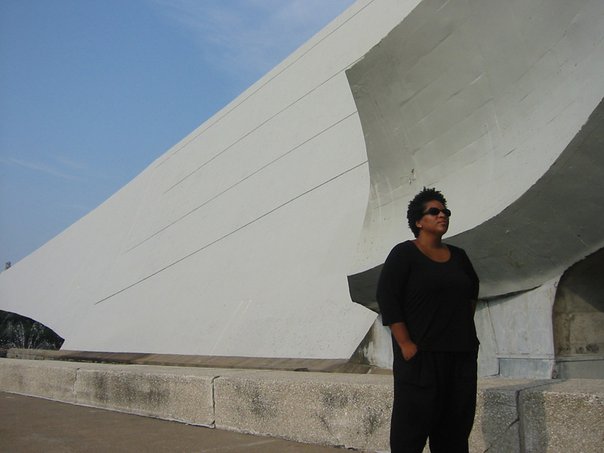
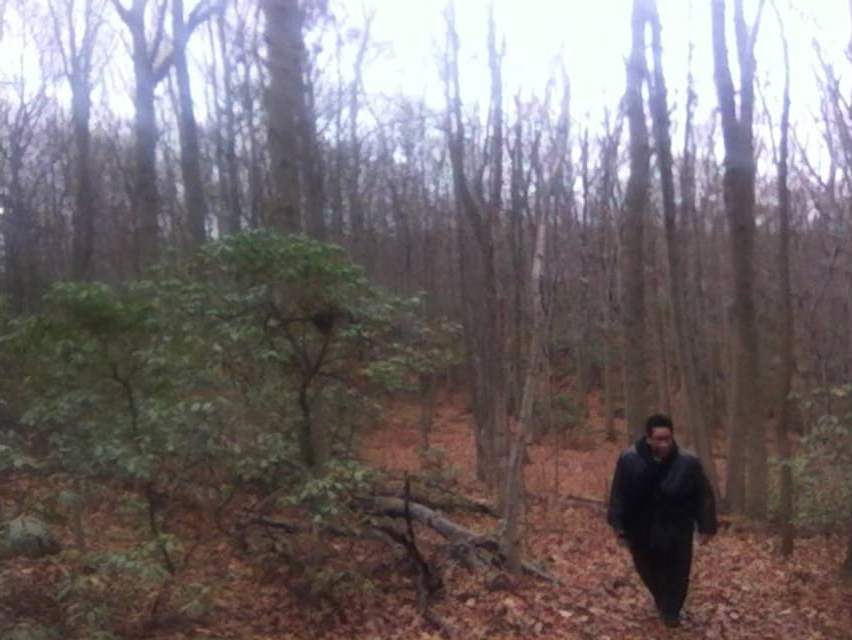
Once the idea of composing for space became my focus, I began with three discrete, yet interrelated environments—an airport, a woodland and a  body of water—each being, at once, vast and intimate. Rather than focus on the material form, I place the emphasis on the essence and impermanence of nature and architecture, evoking both absence and presence through ambient sound. Although they are not site-specific, they refer to places I’ve frequented as a child, and there is a personal allegory to each one. In addition, I did recording on Marcel Breuer’s Stillman House II, entitled, “The Juice of Stone,” which combines material sounds with melody meant to evoke the spirit of bringing the outdoors in, and vice versa, as dear friends of mine who lived there, observed. When I was commissioned to do “Per/Severance” — an installation about a New England river that once had an important role in the 19th Century textile industry —my objective was to find a way to bring the river into the (gallery) space without a physical water element. Architectural spaces often connote occupancy. I write from a nostalgic perspective, so, often the sounds or voices have a haunting quality to them. I don’t do it to necessarily illicit fear, but a sense of remembrance. Too often, lesser known, but no less important stories have unfolded in these spaces.

Composer and sound artist Mary Edwards has created an interpretive soundscape of the Quequechan River, a body of water whose history is familiar to those who live and work in Fall River, Mass. For more than a century it was the lifeblood of textile manufacturing. Its course runs through the city, shallow and sluggish along its southern end, and fast and furious as it heads down toward the bay. In service to industry, the river was modified so much that its original path is unknown. More recently it was buried under the city to accommodate the expansion of Route 195. Edwards came to Fall River several times to study the river, to understand its relationship to the city, and to find the remaining places where it can still be seen, and heard. Her sound installation is evocative of many things, the memories that the water still carries, the conversation it would have if someone were there to listen.

You’ve lived in the NYC area for a majority of your life. Do you think living in an audibly jarring urban environment has influenced the way you pick up on the softer sounds in nature?

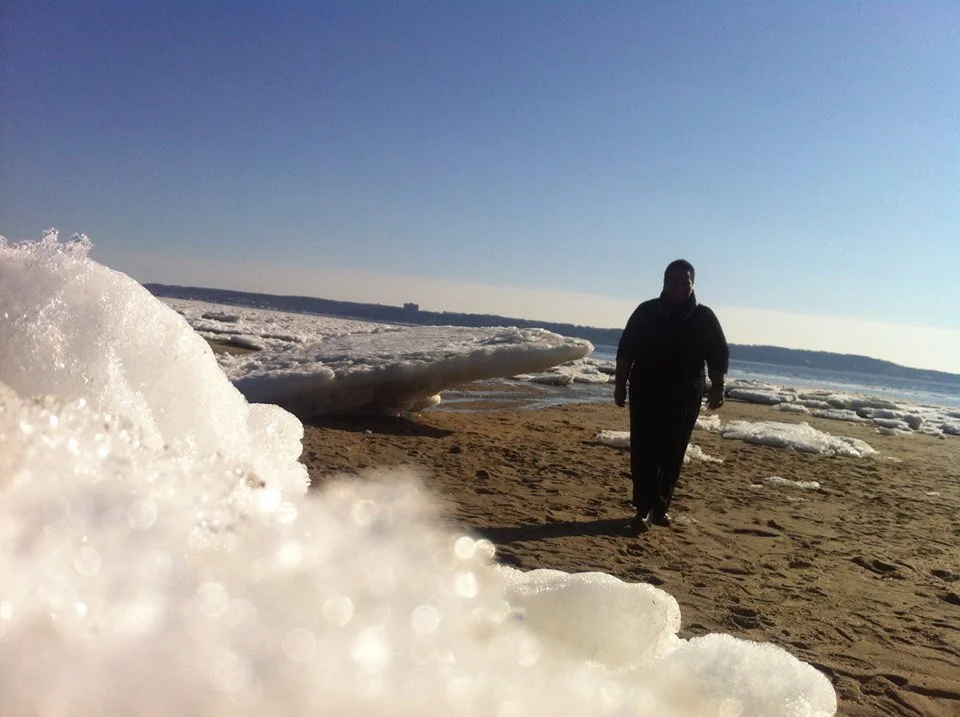
It has, and yet, I’ve found some surprisingly quiet oases in the city. While there’s no such thing as actual silence, there are soft, repetitive sounds that emanate from bird calls, insects, wind and the streams and waterfalls hidden in the heart of the boroughs. As a result, I’ve written more nature-inspired pieces, although, I also cherish the calm of a public place like a concert hall, library or museum, or place of worship where a hush or low-din of acknowledgement at appropriate times is a respectful action. Last year, I performed environmental composer John Luther Adams’ “Inuksuit” with a 40-piece percussion ensemble. His recent works are immersive, and are meant to be heard out of doors, or from a non-traditional seating arrangement. It is with purpose that his pieces are to compete or emulsify with random noises in the environment. That day, I heard the hum of overhead planes, as well as birds, and it all seemed to fit. You never know if the work is going to be enhanced by machine or mammal. Recently, I’ve been composing more instrumental works that include vocables (or wordless vocals) and guttural sounds in place of lyrics. The intonations are appealing to me. There’s such beauty and sometimes humor in succinct expressions and intimate emissions that come, not only from the throat, but the furthest depths of the body. I grew up listening to a lot of Ennio Morricone’s music, as well, and he employs a lot of non-traditional instrumentation and vocalization that translate well to film scores and environmental imagery. Like Morricone, I lean to the natural world, and the human presence that is invariably part of it. I’ve spent this past Winter into early Spring in a place surrounded by woods and ocean—the Manhattan skyline is to my left, and a habitat of seal, deer and foxes to my right. The presence of all this —and the sheer juxtaposition of environments—enhances my work. To quote poet Gary Snyder, “Nature is not a place to visit. It is home.”

I’ve known you now for, oh, almost 15 years, and I don’t think I ever asked you about your fascination with Burt Bacharach. Can you tell me how that all started?

He’s always been sort of an icon for me, the way his professional and personal life melded right before our eyes—you know, that image of him at home, dashing in a white sweater draped over his shoulders, sitting at the piano, tinkling out dreamy seventh notes while Angie Dickinson casually leans forward with a Martini and Rossi in her hand? Seriously, he’s much more than that. I’ve always got a kick out how he wrote three-bar arrangements at a time when everyone else was writing four. That, and the acute melodic mood shifts clearly make his songs memorable. They were among some of the first I’d ever heard—probably in utero,—and the complexity of his music combined with the simplicity of Hal David’s lyrics makes one take pause. Theirs was the partnership I found truly exiting. It reminds me of Modern architecture, the challenge of knowing exactly what to leave in and what to leave out, and make it easy to live with.

"No Man Must Speak But in Whispers" is an intriguing sound installation inspired by the tale of Moby Dick from the perspective of the whale. Can you talk more about this piece?

In this piece, I advocate for the fictional Whale. When an animal strikes, it is likely they have been provoked. There is a small percentage of those who are aware of this. Our culture teaches us to avenge our unfounded fears, or worse, “tame” the wilderness into submission. There is purpose for all living creatures, and if we understood how they communicate—in this case, through whale song—we would be less threatened by their existence. When I give lectures on Acoustic Ecology (the relationship, mediated through sound, between living beings and their environment), I often talk about  “Environmental Munchausen’s”—how we are apt to damage our habitat, yet take credit for reparations that fall short of responsibility, whether to the land or other living beings. Transformation begins with understanding. If Moby Dick was a contemporary work, Captain Ahab would probably be a subcontractor for a marine mammal park and be taken to task.

No Man Must Speak But in Whispers, Mary Edwards' ambient soundscape inspired by the tale of Moby Dick from the perspective of the Whale.

Human (or not) heroines or heroes?

A gentle soul with a firm conviction. Anyone whose altruism is tempered by modesty. My family. My teachers.

I haven't ever seen you wear anything but black (with an occasional pop of white). It’s a simple, but classic look and I can’t imagine you ever wearing anything else. Describe your daily uniform and why you’ve chosen it. Also, would you ever consider wearing something else? If so, what would that be?

I own multiples of black three-quarter sleeve v-neck shirts and custom-tailored trousers. The material is variable, depending on the climate, and I wear more formal versions with accouterments. There are white, charcoal and midnight blue items in my collection as well. It works for ease and efficiency of daily dress, it’s one less thing to think about, and saves time in the schedule. I’d consider wearing yellow chiffon. No, actually, I wouldn’t.

I used to spend days with you in your tiny little apartment in Fort Greene, Brooklyn, and was always impressed by your lack of “stuff." Everything was in its place and had a purpose, but at the same time, nothing about the space was cold or overly contrived. I think this design aesthetic reveals itself in your sound pieces. Do you?

Oh, yes, very much. God, I loved that apartment. It was bright and airy and very high up, with a peaceful view. It had the best sunrises and sunsets, and the atmosphere was conducive to producing so much work. I wrote three albums, there. That space afforded clarity. I do think distillation is the common denominator to both my design aesthetic and compositional approach, how chaos gets quickly sorted out to make room for the right amount of elements.

 Where do you find yourself most days at 3:34 pm?

 Thanking the stars I made it past 3:33, and looking forward to 3:35.with aplomb.

 You and I have enjoyed many meals together and I know you appreciate food as much as I do. What is one of the more memorable meals you’ve had in the last 13 days?

I had the most excellent miso cod. I enjoy simple meals with an elegant, yet unpretentious presentation. I like to savor a meal—from the first aroma that readies the palate, to each individual bite that is a cause for celebration. Even when a good meal can evoke a particular memory, it still keeps you so intently focused on present, and the beauty of the preparation.

What sounds are going on around you right now, at this very moment?

I’m listening to the sound of the ocean. It was frozen in sections-- all throughout the Winter, audibly constrained, as if it were in a bottomless slumber. In a matter of months, it’s gone from a poignantly dreamy tone to a bright and crisp succession of unencumbered waves.

tags: Mary Edwards, artists I love interviews, Sounds, Sound Installation Artists, Music, architecture, design
Friday 04.24.15
Posted by felicity fenton
Comments: 1
 

An Interview with Donna Catanzaro

I'm one of the lucky mammals who spent a few years of my life in Goddard's MFAIA program with the lovely, whimsical, sassy and irreverent Donna Catanzaro. Her collages are a careful (and never too preachy) blend of political statements and images found in vintage magazines and newspapers. Check out more of Ms. Catanzaro's work HERE. 

There are loads of images from ads of the 50’s and 60’s in your collage work. What about this era motivates you?  

It’s an era that reminds me of my earliest memories: of watching I Love Lucy reruns with my Mom. In fact, many of the ads remind me of my Mom. I imagine her reading the same magazines, deciding which floor wax to buy, which recipes to cook, dreaming of a new living room set. I grew up rebelling against the 50’s conservatism, so it’s rather ironic that I use these images, and that’s how I use them, ironically. I like the colors, and the exuberance the people in the ads have for the mundane products they worship. And nostalgia is a perfect vehicle for humor. If I staged them in the present day, they wouldn’t be as funny.

Feminism, the environment and politics all play a big role in your work. Has this always been the case?  

I used to paint, mostly landscapes and then abstract landscapes. But at some point I became frustrated. While the process of painting was emotionally and spiritually fulfilling, I wasn’t able to convey humor, politics, or ideas. It seemed selfish to be letting my emotions flow on paper and canvas when there was so much I wanted to say. But I wasn’t a skilled enough painter to accomplish it on canvas. So when I started working in Photoshop a light bulb went off. Actually it was more like a pinball machine winning a free game! And I realized I could say anything I wanted using any image I could find.

I love that you incorporate humor into your work and think it’s a smart way to address some of the more chaotic/shitty things going on in the world. What makes you laugh? 

I love all types of humor, but slapstick and visual humor are my favorite. This past week I’ve been watching old Jack Benny shows from the ‘50’s. Last week I watched a few old episodes of The Munsters.  I admire the old Vaudeville comedians, the Marx brothers, TV shows from my youth such as Get Smart, and Monty Python. Silly comedy that uses visual gags is my favorite. 

Where do your ideas begin?  

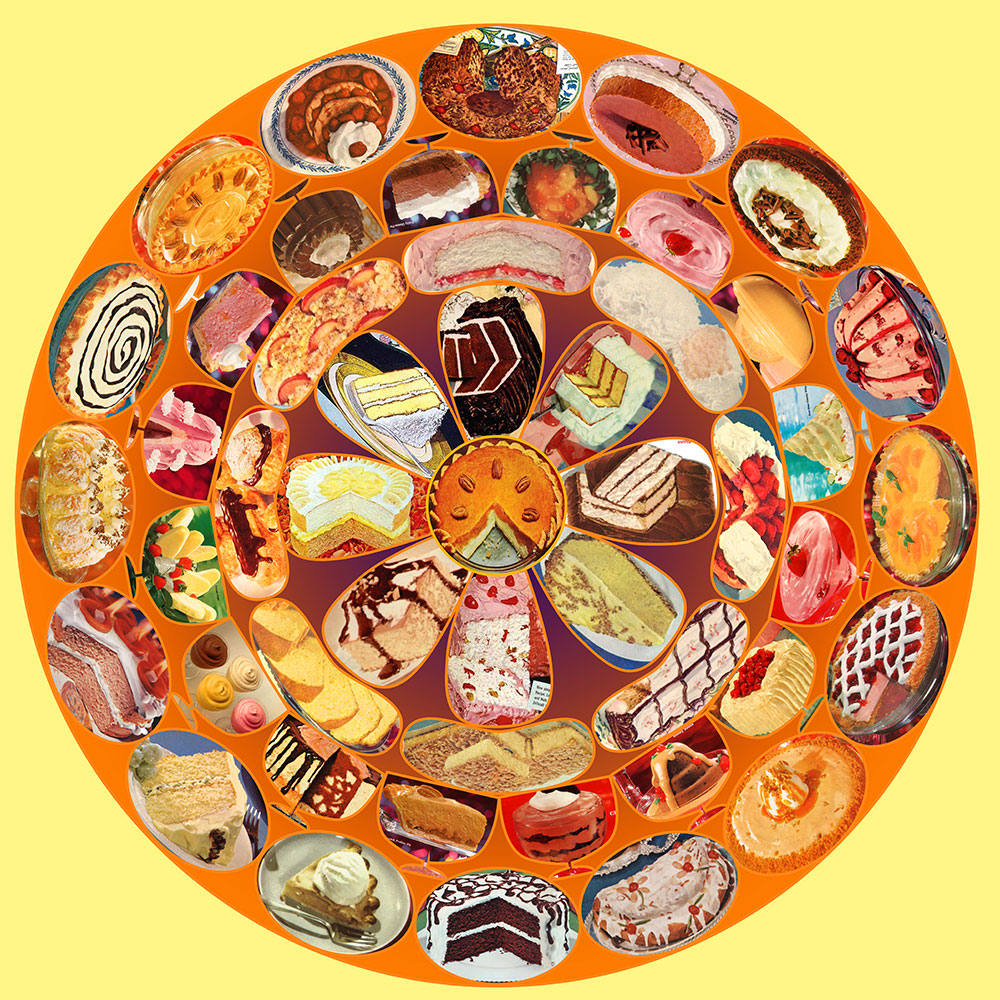
Often it’s the theme of a show I want to enter, and I’ll sit down and brainstorm on that theme. Sometimes it’s something I hear on NPR or a factoid I come across on the internet that gets me going. Sometimes I’ll come across an interesting, funny image browsing through one of my old magazines, or on the Internet, I’ll see a weird picture and think, oh I have to do something with that. The food Mandalas were influenced by witnessing a group of Tibetan monks creating a sand mandala at a local library. It was mesmerizing. Then a couple of days later I found myself working on a community mandala project, and then a couple days after that I was invited to friend a mandala site on facebook, and I thought, the universe is telling me to make mandalas! I must make one! So I try to let the inspiration come from anywhere, including the little voices in my head. 

Continued below...

Fabulous Fifties Dessert Mandala
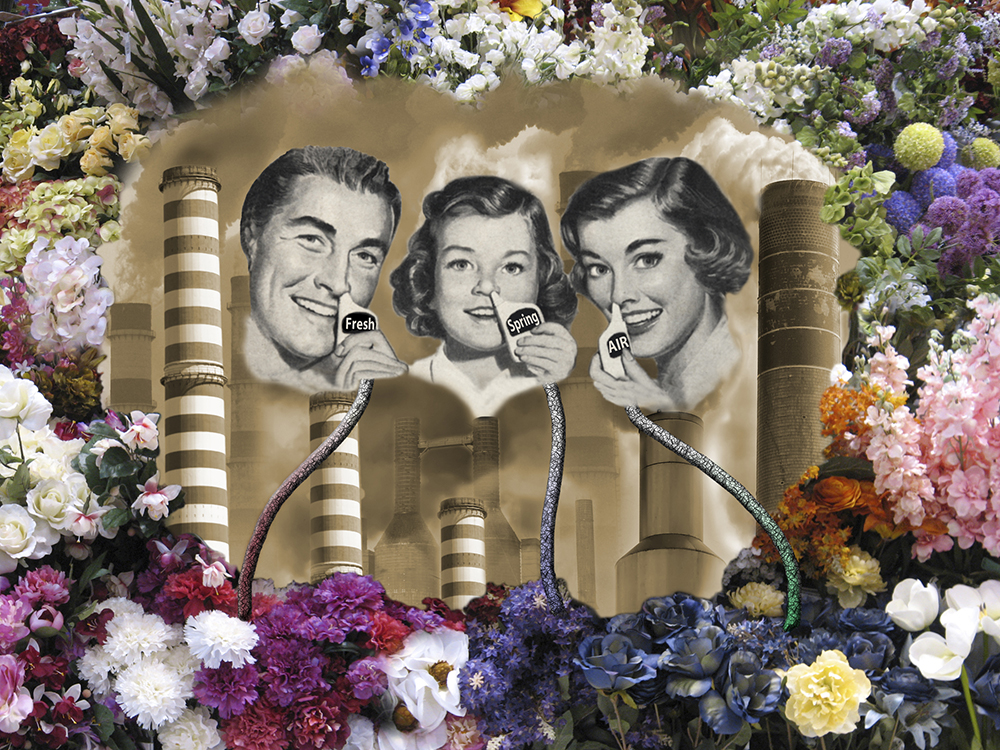
Pass the Inhaler
Pass the Inhaler
You Think You’re Drinking Water But You’re Really Drinking Oil
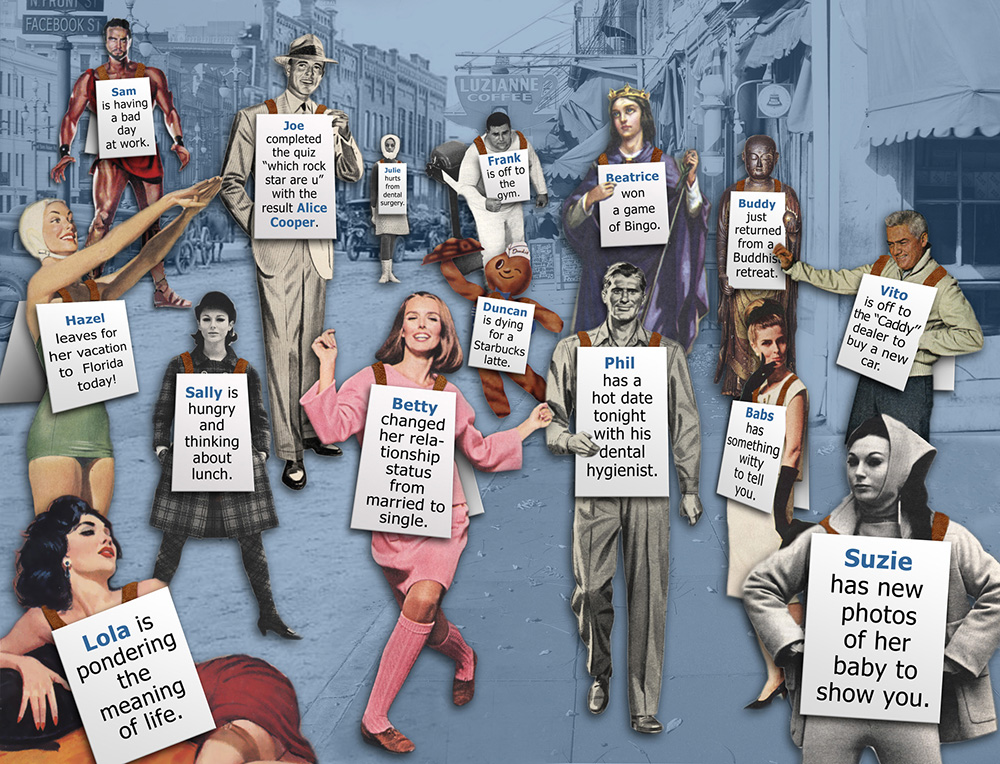
Imaginary Friends
Imaginary Friends
Factory Food or Local Food
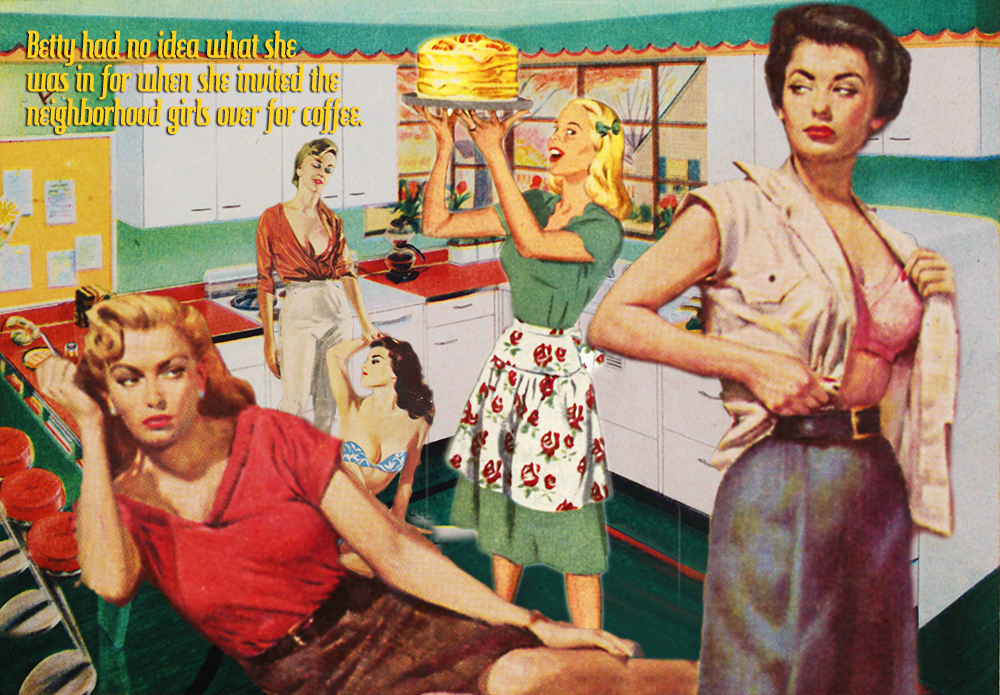
Lesbian Pulp Meets 1960’s Domesticity
Oil Zombies
Oil Zombies
Pasta Wedding
Pasta Wedding
Tea Bag Zombies
Tea Bag Zombies
If Women Ruled the World
Fabulous Fifties Dessert Mandala Pass the Inhaler You Think You’re Drinking Water But You’re Really Drinking Oil Imaginary Friends Factory Food or Local Food Lesbian Pulp Meets 1960’s Domesticity Oil Zombies Pasta Wedding Tea Bag Zombies If Women Ruled the World

Do you have a daily art practice?  

Yes, I force myself to sit in front of the computer and accomplish something. If there’s a deadline looming, I may work all day. If not, maybe just a few minutes. It’s hard to do, there are so many distractions, but I always feel better after I accomplish at least a little bit of artwork every day.

Digital or analogue?  

Entirely digital these days, though I often make rough sketches to brainstorm and plan out my designs. I would love to start drawing again, I really miss it.

What are you reading? 

I just started “Transatlantic” by Colum McCann. Before that I read “Five Days at Memorial: Life and Death in a Storm-Ravaged Hospital” by Sheri Fink. I prefer non-fiction, especially books about history.

Describe your everyday ritual.  

Wake up at 6:30, drink coffee and stare into space (my form of meditation), check email, get distracted by facebook, eat oatmeal, yogurt & fruit for breakfast, work on artwork or freelance graphic design or something on the computer (today it was taxes, yuck), more distractions, lunch, outside exercise activity on a good day (walk, snowshoe, bikeride…), afternoon tea and chocolate, practice ukulele, projects around the house, more sitting in front of the computer updating my website and other internet distractions, dinner, watch something on Netflix or read, in bed at 10. A lot of sitting in front of the computer and way too many distractions!

Food is another focal point in your collages. How has this influenced your own eating habits? 

I LOVE food. It’s my favorite thing in the world and I love the photos in old cookbooks. I cook with the same cookbook my mother used, a 1960 version of Betty Crocker, or one of the old cookbooks I’ve collected or inherited from her. I feel like I’m channeling her when I cook with them. I like ordinary food, the food of my childhood: pasta, fish, meatloaf, mashed potatoes, blueberry pie. I like to eat food from the past, wholesome homemade food without chemicals.

What is on the top shelf of your refrigerator?  

What a great question! Eggs, yogurt, coffee, hummus, cottage cheese, a can of lemon-lime seltzer, and dried apricots.

Influences?
Some influences that come to mind are Hannah Höch, John Heartfield, James Rosenquist, Martha Rosler, Barbara Kruger, current artists such as Sally Edelstein and one you turned me on to: Eugenia Loli. 

tags: Donna Catanzaro, artists I love interviews, artist interview series, art, collage
Sunday 03.15.15
Posted by felicity fenton
 
Newer / Older

Go outside. Good things happen outside.